

Blog
What Does “Pet-Safe Candle” Really Mean?
Tuesday 3rd March 2026
Natascha De-Bank - Founder, Folly & Wild
We all love wandering around shops smelling different fragrances, admiring the colours and jars, and imagining which candle might look nicest in our homes.
But have you ever noticed that every now and again, when a candle is burning, your dog quietly gets up and leaves the room?
I did.
Sometimes Winston would go and lie somewhere else in the house. Sometimes he just seemed a little unsettled for no obvious reason. Other times he appeared completely fine.
And that got me thinking.
If Winston occasionally chooses to leave the room when a candle is burning… what exactly is he sensing that I can’t?
It made me start asking questions.
What are candles actually made from?
What are we breathing in?
And more importantly for dog owners… how might it affect our pets?
⸻
Why Dogs Experience Scent So Differently
Dogs experience the world through scent in a way humans simply can’t imagine.
While humans have around five to six million scent receptors, dogs can have over two hundred million, depending on the breed. Their sense of smell isn’t just stronger, it’s an entirely different sensory experience.
That means scents we might find pleasant or subtle could feel much stronger to a dog.
Sometimes they may simply prefer to move away from it.
That doesn’t necessarily mean a candle is harmful, but it does highlight something important: dogs experience fragrance very differently from us.
Research around home fragrance and indoor air quality is still developing, and studies don’t always agree on the effects. What we do know, though, is that dogs are very good at regulating their own comfort.
If they don’t like a scent, they’ll often quietly remove themselves from it.
And honestly, that behaviour is often one of the most useful indicators we have.
⸻
The Problem With the Phrase “Pet-Safe”
You’ll often see candles described as:
• pet-safe candles
• dog-safe candles
• pet-friendly candles
• non-toxic candles for pets
The challenge is that these terms aren’t regulated in the candle industry.
That means brands are free to use them in very different ways.
For some companies it may mean they use natural wax. For others it may simply be a marketing phrase without much explanation behind it.
As candle makers ourselves, this can actually be quite frustrating because there is no universal definition that customers can rely on.
So if you’re trying to choose candles for a home with pets, the best thing you can do is ask questions.
Smaller independent brands are often the easiest place to start, because you can usually speak directly to the people who actually make the products.
You can ask things like:
• How are your fragrances formulated?
• Are they assessed by a chemist?
• Do you have safety documentation?
• What ingredients are used in the wax?
Those conversations can often tell you far more than the wording on a label.
⸻
Wax Types and Why They Matter
Another factor worth considering is the type of wax used in a candle.
Many traditional candles are made using paraffin wax, which is derived from petroleum during the oil refining process. Paraffin is widely used because it burns slowly and holds fragrance well, which also makes it relatively inexpensive.
However, when burned, paraffin candles can release small amounts of compounds such as toluene and benzene, which are by-products of petroleum combustion.
Because of this, many people choose to look for plant-based wax alternatives instead.
Waxes such as olive wax, soy wax, coconut wax and beeswax are often selected by candle makers looking to create products that burn more cleanly when properly formulated.
Of course, wax alone doesn’t determine the quality of a candle. Wick size, fragrance balance and overall formulation all play a role.
But understanding the type of wax used can help people make more informed choices.
⸻
Fragrance Ingredients: Essential Oils vs Fragrance Oils
Another area that often causes confusion is fragrance.
Some people assume that essential oils are always safer than fragrance oils, but it’s not quite that simple.
In reality, many essential oils are not recommended for use around dogs, particularly when diffused or used heavily in enclosed spaces.
Fragrance oils, when professionally formulated and assessed, can actually provide a much more controlled and balanced scent profile.
Responsible candle brands will formulate fragrances according to industry safety standards and ensure they are used at appropriate levels.
The key isn’t whether the scent comes from an essential oil or a fragrance oil, it’s how that fragrance has been formulated and assessed.
⸻
Ventilation Matters More Than You Think
Regardless of the candle you choose, one of the most important pieces of advice is simple: always burn candles in well-ventilated spaces.
Dogs should always have the option to leave the room if they want to.
Just like humans, dogs have scent preferences. Sometimes they simply decide a fragrance isn’t for them.
Allowing that choice is one of the easiest ways to keep everyone comfortable.
⸻
Why We Took a Different Approach
All of these questions eventually led me to look much more closely at how candles are formulated and tested.
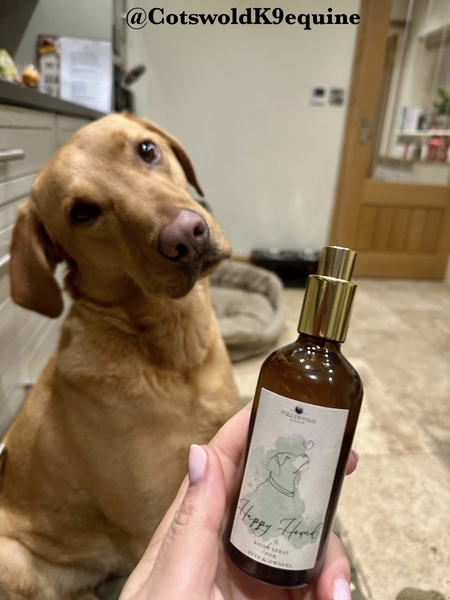
When we developed the Happy Hound aromatherapy range, the goal was to create home fragrance designed specifically for homes shared with dogs.
Each blend is reviewed by a professional chemist who produces the required safety documentation and ensures the formulation meets industry guidelines. We also discuss formulations with our consulting vet so that everything used is appropriate for a home environment with pets.
The aim wasn’t just to create another candle.
It was to develop something that felt like a more thoughtful option for dog owners who still want their homes to smell beautiful.
So if you choose one of our candles or aromatherapy products, you don’t need to spend hours researching wax types, fragrance levels or formulation standards yourself.
We’ve already done that work for you.
⸻
Final Thoughts
Candles and dogs can absolutely coexist in the same home.
But like many things involving our pets, it helps to be a little more aware of how our choices might affect them.
Understanding ingredients, choosing well-formulated products and allowing plenty of ventilation can make a big difference.
And sometimes the simplest signal of all is this:
If your dog quietly leaves the room, they might just be telling you that scent isn’t quite their favourite.